
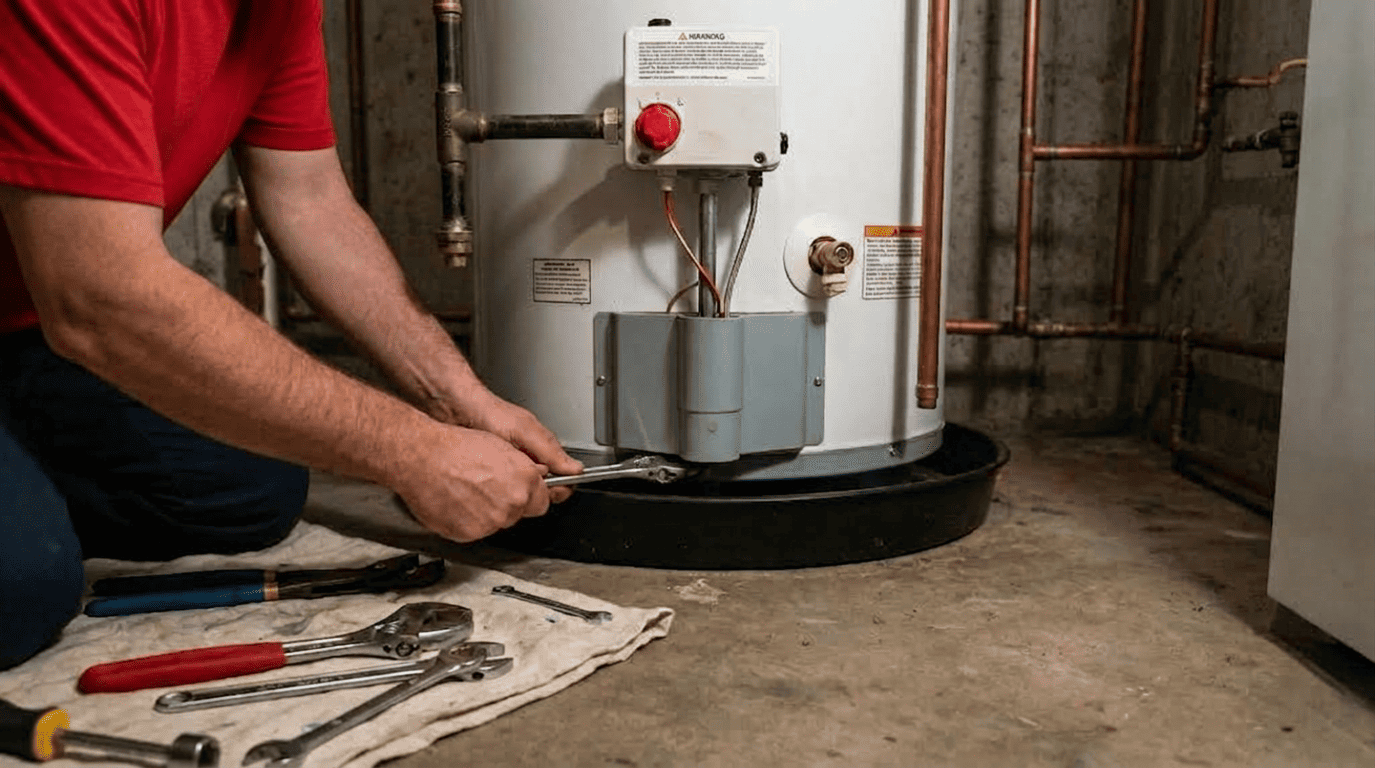
A water heater rarely fails without giving you some warning.
You may notice that the hot water does not last as long as it used to, hear unusual sounds from the tank, see rusty-looking water, or find moisture around the unit. One warning sign by itself does not necessarily mean you need a new water heater. But when several problems begin appearing together—especially on an older system—it may be time to consider replacement.
For homeowners in O’Fallon and throughout the St. Charles County area, recognizing these signs early can help you plan for a replacement instead of dealing with an unexpected loss of hot water.
How Long Does a Water Heater Usually Last?
The service life of a water heater depends on the type of system, water conditions, installation, maintenance, usage, and other factors.
A traditional tank-style water heater can eventually develop internal corrosion and component wear as it ages. Even when individual parts can still be repaired, an older system may become less reliable and require increasingly frequent attention.
That is why age should be considered together with the water heater’s overall condition.
An older water heater that continues working reliably may not need immediate replacement. An older unit that is showing several warning signs deserves closer attention.
1. Your Water Heater Is Getting Older
Age is one of the first things to consider.
As a water heater gets older, components inside and around the system experience normal wear. The tank can also become more susceptible to corrosion over time.
If your water heater is older and you’re beginning to notice performance problems, it may be worth having the system evaluated before it develops a major failure.
Age alone does not automatically mean replacement is necessary. It becomes more significant when combined with other symptoms.
2. You Keep Running Out of Hot Water
Has your household started running out of hot water much sooner than it used to?
A reduction in available hot water can have several causes. The heating components may not be operating properly, sediment may be affecting performance, or the water heater may no longer be meeting your household’s demand.
In some situations, a repair can restore performance.
However, if an older unit continues to struggle with hot-water production despite repairs, replacement may provide a more dependable solution.
If your household’s hot-water needs have increased, proper sizing is also important when selecting a replacement.
3. The Water Heater Makes Loud or Unusual Noises
Popping, rumbling, banging, or other unusual sounds can indicate sediment buildup or other problems affecting the water heater.
Sediment can collect inside a tank over time. When the water is heated, trapped water beneath the sediment can create steam bubbles that contribute to popping or rumbling sounds.
Occasional noise does not automatically mean the water heater needs to be replaced. But persistent or worsening noises—particularly on an older unit—are worth investigating.
4. The Hot Water Looks Rusty
Rust-colored or unusual-looking hot water can be a warning sign.
The cause may be related to corrosion inside the water heater or another part of the plumbing system. Determining the source is important because rusty water does not automatically mean the water heater tank has failed.
If the tank is deteriorating internally, continued operation may eventually lead to a leak.
An inspection can help determine whether the issue is isolated or part of a larger problem with the water heater.
5. You See Water Around the Water Heater
Moisture around a water heater should not be ignored.
But first, the source of the water needs to be identified.
Water can come from:
- Supply connections
- A drain valve
- The temperature and pressure relief valve
- Other fittings or connections
- Condensation
- The water heater tank itself
If the tank itself is leaking, replacement is generally necessary because a damaged storage tank is not something that can simply be patched for long-term use.
If the leak is coming from a connection or replaceable component, the solution may be much simpler.
6. The Water Heater Requires Frequent Repairs
One repair does not necessarily mean a water heater has reached the end of its life.
However, repeated repairs can be a different story.
If you have recently repaired one component and another problem appears shortly afterward, the cost and inconvenience can start to add up.
At that point, it is useful to look at the entire system rather than considering each repair separately.
Ask:
- How old is the water heater?
- How many repairs has it needed?
- Is the tank showing corrosion?
- Is hot-water performance declining?
- Is another major component beginning to fail?
- Would replacement provide greater reliability?
A professional evaluation can help you compare continued repairs with replacement.
7. The Tank Shows Visible Corrosion
Visible rust or corrosion around the water heater deserves attention.
Surface corrosion around a fitting may be relatively minor, while corrosion associated with the tank itself can indicate a more serious problem.
Once corrosion significantly compromises the tank, replacement may be the practical solution.
This is another reason not to wait until a small warning sign becomes a major leak.
8. The Water Takes Longer to Heat
A noticeable change in recovery time can indicate that the water heater is no longer performing as it once did.
If showers become shorter because the household runs out of hot water, or the system takes significantly longer to recover between uses, the cause should be investigated.
The issue could involve a heating component, sediment, sizing, or another system problem.
For an older water heater that is already showing several warning signs, declining recovery performance can be another reason to consider replacement.
9. Your Energy Costs Are Increasing Without a Clear Explanation
A water heater that is working less efficiently can require more energy to provide the hot water your household needs.
However, higher utility costs alone do not prove that the water heater is the cause. Seasonal changes, household usage, utility rates, and other appliances can also affect energy consumption.
If increased energy use occurs alongside declining hot-water performance or other water heater problems, having the system checked can help identify whether the water heater is contributing to the change.
10. Your Water Heater Has Multiple Warning Signs at Once
This is often more important than any individual symptom.
For example, consider an older water heater that:
- Runs out of hot water quickly
- Makes loud rumbling sounds
- Has visible corrosion
- Has required several repairs
- Takes longer to heat water
Any one of these symptoms might have a repairable cause.
Together, however, they suggest that the system should be evaluated as a whole.
At that point, replacing the water heater may make more sense than continuing to address problems one at a time.
Does an Older Water Heater Always Need to Be Replaced?
No.
A water heater’s age is only one factor.
If an older unit is still operating reliably, producing adequate hot water, and has no significant signs of deterioration, immediate replacement may not be necessary.
On the other hand, an older water heater with a leaking tank, significant corrosion, repeated failures, or declining performance may be approaching the point where replacement is the more practical option.
The goal is not to replace a water heater simply because it has reached a certain age. The goal is to recognize when the condition and reliability of the system no longer justify continued repairs.
Repair or Replacement: How Do You Decide?
The decision usually comes down to the condition of the entire system.
Repair may be worth considering when:
- The water heater is relatively newer
- The problem is isolated
- The tank is in good condition
- The repair is straightforward
- The system otherwise performs reliably
Replacement may make more sense when:
- The tank itself is leaking
- The system has significant corrosion
- Multiple components are failing
- Repairs are becoming frequent
- Hot-water performance continues to decline
- The unit is older and becoming unreliable
If you’re unsure, a professional assessment can help you understand the condition of the existing system before you commit to either option.
Don’t Wait for a Complete Water Heater Failure
A water heater that stops working completely can leave your household without hot water when you least expect it.
Even more importantly, a leaking tank can potentially cause water damage around the installation area.
If you notice multiple warning signs, planning ahead gives you more opportunity to evaluate replacement options, choose an appropriately sized system, and schedule installation before the existing unit becomes an emergency.
For homeowners who determine that replacement is the right option, Arch Plumbing provides water heater installation in O’Fallon, MO and serves homeowners throughout the surrounding St. Charles County area.
What Should You Do If Your Water Heater Is Showing These Signs?
Start by identifying the symptoms rather than assuming the water heater needs to be replaced.
A plumber can inspect the unit, determine where a problem is coming from, assess the condition of the system, and explain whether repair or replacement is appropriate.
If the water heater is still repairable and in good overall condition, a repair may be enough.
If the system is deteriorating or becoming unreliable, replacing it can provide a more dependable long-term solution.
Frequently Asked Questions
How do I know if my water heater needs to be replaced?
Warning signs include a leaking tank, repeated repairs, significant corrosion, declining hot-water performance, unusual noises, and an older system developing multiple problems. These symptoms should be evaluated together rather than relying on age alone.
What is the biggest sign that a water heater needs replacement?
A leaking storage tank is one of the clearest signs that replacement may be necessary. Other factors, including age, corrosion, repeated repairs, and declining performance, can also indicate that replacement should be considered.
Is a noisy water heater a sign it needs to be replaced?
Not necessarily. Popping or rumbling sounds can be related to sediment buildup or other issues that may be repairable. However, persistent noise on an older water heater—especially when combined with other problems—should be evaluated.
Can an old water heater still be repaired?
Yes. An older water heater can sometimes be repaired if the tank remains in good condition and the problem is limited to a repairable component. The overall condition and repair history should be considered before deciding.
Should I replace my water heater before it completely fails?
Planning a replacement can make sense when an older system is showing multiple warning signs or becoming unreliable. Replacing it before a major failure can give you more control over the timing and selection of the new system.
Let’s Book Your Appointment
Fill out the form below and our team will contact you shortly to confirm your appointment.




