
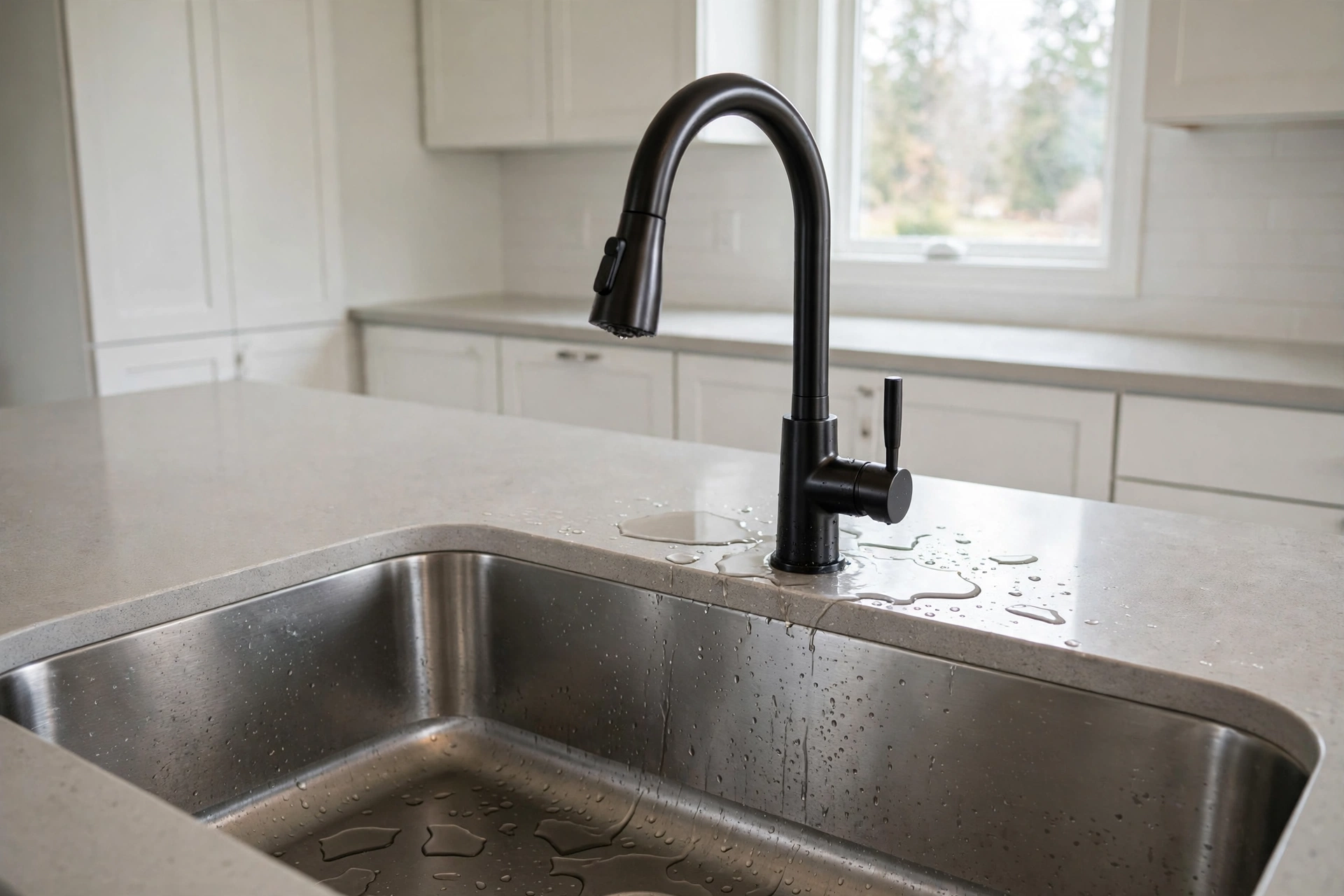
Water pooling around your kitchen faucet can seem like a minor inconvenience, but recurring moisture can damage the sink area, seep into the cabinet below, and signal a problem with the faucet or its plumbing connections.
If your kitchen faucet is leaking at the base, the most important step is to identify where the water is coming from. A worn internal seal, a damaged cartridge, loose mounting hardware, or water escaping from another connection can produce similar symptoms but require different solutions.
For homeowners in St. Charles and St. Louis County, understanding the likely cause can help you decide whether a repair is appropriate or whether replacing the faucet is the better long-term option.
Why Is Water Leaking Around the Base of Your Kitchen Faucet?
The faucet base is where the fixture meets the sink or countertop. Water can collect there because of a problem inside the faucet, a deteriorated seal, or water that has splashed onto the surrounding surface.
Here are the most common possibilities to consider.
1. A Worn Faucet Cartridge or Internal Seal
Many kitchen faucets use an internal cartridge or valve mechanism to control water flow. Over time, internal components can wear out, allowing water to escape when the faucet is operated.
You may notice water around the faucet base after turning on the handle, even when the supply connections beneath the sink appear dry.
Depending on the faucet design, replacing a cartridge or another compatible component may resolve the problem without requiring an entirely new faucet.
The correct repair depends on the faucet’s make, model, and internal design.
2. A Damaged or Deteriorated Base Seal
Some faucets have seals or gaskets around the mounting area to help prevent water from entering spaces beneath the fixture.
If water repeatedly collects around the base, a deteriorated seal may be contributing to the problem. However, water splashing from the sink or leaking from another part of the faucet can create similar symptoms.
A plumber can inspect the mounting area and determine whether the seal needs attention or whether the water is coming from somewhere else.
Simply applying more caulk around the faucet is not a reliable solution for every leak. The underlying cause should be identified first.
3. Loose Faucet Mounting Hardware
Kitchen faucets are secured to the sink or countertop with mounting hardware. If the fixture becomes loose, it may move during normal use and allow water to reach areas that should remain dry.
Signs may include:
- The faucet moves when you turn the handle or pull out the spray head.
- Water repeatedly collects around the mounting area.
- The faucet no longer feels firmly secured.
Loose mounting hardware may be repairable, but overtightening it can damage the fixture or the sink. If the faucet is unstable or the source of the leak is unclear, have the mounting assembly inspected.
4. A Leaking Pull-Down Spray Hose or Faucet Connection
Some kitchen faucets have pull-down or pull-out spray heads connected to flexible hoses.
If a hose, connection, or internal fitting leaks, water may travel down the faucet body and collect around the base. In some installations, moisture may also appear inside the cabinet below the sink.
Look for recurring dampness beneath the faucet, around accessible hose connections, or inside the cabinet after the spray function has been used.
A damaged hose or connection may be repairable if compatible parts are available. The faucet may not need full replacement.
5. Water Is Splashed Around the Faucet During Use
Sometimes the faucet itself is not leaking at all.
Water from washing dishes, using the spray head, or filling containers can collect around the base and appear to come from the fixture.
To help distinguish splashing from a plumbing leak, dry the sink and faucet area, then observe whether moisture returns during ordinary use. Avoid operating the fixture if water is reaching electrical equipment or if you suspect an active leak beneath the sink.
If the area becomes wet repeatedly without an obvious explanation, a professional inspection can help identify the source.
How to Tell Where the Kitchen Faucet Leak Is Coming From
The location and timing of the water can provide useful clues, although they do not confirm the cause by themselves.
Water appears around the base only when the faucet is running: The faucet body, internal seals, mounting area, or water splashing may be involved.
Water appears around the handle: An internal seal or cartridge may be worn, depending on the faucet design.
Water collects inside the cabinet below the sink: The supply lines, faucet connections, spray hose, sink drain, or another plumbing component may be leaking.
Water appears even when the faucet has not been used: A pressurized supply connection or another nearby plumbing component may need inspection.
A faucet leak can be difficult to diagnose because water often travels along surfaces before dripping onto the cabinet floor. Avoid assuming that the component directly above a puddle is necessarily the source.
If you cannot identify the cause safely, a plumber can inspect the faucet and surrounding connections.
Should You Repair or Replace a Leaking Kitchen Faucet?
The right choice depends on the condition of the fixture, the source of the leak, the availability of compatible parts, and the overall cost and practicality of the repair.
When Kitchen Faucet Repair Makes Sense
Repair may be the more practical option when:
- The faucet body remains in good condition.
- The problem involves a replaceable cartridge, seal, hose, or connection.
- Compatible replacement parts are available.
- The fixture still meets your household’s needs.
- The repair can address the leak without extensive additional work.
For example, a worn cartridge in an otherwise sound faucet may be repairable without replacing the entire fixture.
When Kitchen Faucet Replacement Is Worth Considering
Replacing the faucet may make more sense when:
- The faucet body is cracked, badly corroded, or damaged.
- Compatible repair parts are unavailable.
- Leaks continue after appropriate repairs.
- Several components have deteriorated.
- You are remodeling your kitchen or want a different faucet style.
- The overall condition of the fixture makes repeated repairs impractical.
A replacement may also be an opportunity to choose a faucet with a more suitable handle design, spray function, or configuration for your sink.
Before purchasing a new faucet, check the sink’s mounting-hole arrangement, the available space, and the existing plumbing connections. Not every faucet fits every sink without modifications.
The important distinction: Water around the faucet base does not automatically mean the faucet must be replaced. Identifying the source of the leak first helps prevent unnecessary spending.
What Happens During Professional Kitchen Faucet Replacement?
Replacing a kitchen faucet involves more than installing a new fixture. The existing mounting arrangement and plumbing connections need to be checked to ensure the new faucet is compatible.
Depending on the installation, professional work may include:
- Removing the existing faucet and disconnecting its supply lines.
- Inspecting the sink mounting area and accessible connections.
- Installing a compatible replacement faucet.
- Reconnecting the hot and cold water supplies.
- Checking the spray hose and other applicable connections.
- Testing the faucet and checking for leaks during operation.
If the existing supply lines or shut-off valves are damaged, additional plumbing work may be needed. The exact scope depends on the condition of the installation.
Professional installation can also help identify related problems before they cause another leak beneath the sink.
What Should You Do If Your Kitchen Faucet Is Leaking Right Now?
If water is collecting around your faucet, take these steps to reduce the risk of further damage:
- Stop and inspect the area. Look for the general location of the water without dismantling the fixture.
- Dry accessible surfaces. This can help you see where moisture returns, provided it is safe to do so.
- Check the cabinet below. Look for visible water around the supply lines and accessible plumbing connections.
- Protect the cabinet contents. Remove items that could be damaged by moisture.
- Stop using the faucet if the leak continues. If safe and accessible, shut off the appropriate water supply valves.
- Arrange professional service when needed. Persistent leaks, damaged connections, or an uncertain source should be assessed before further use.
Do not touch wet electrical equipment, and do not attempt to repair pressurized plumbing connections while water is flowing.
Addressing a leak early can help limit damage to the cabinet, countertop, and surrounding materials.
Need Kitchen Faucet Repair or Replacement in St. Charles County?
A leaking kitchen faucet can be caused by a small replaceable component, a damaged connection, or a fixture that has reached the end of its useful life. The best solution starts with identifying the source rather than automatically replacing the faucet.
Arch Plumbing provides kitchen plumbing services, including kitchen sink and faucet installation. If your faucet is leaking, loose, damaged, or due for replacement, our team can help assess your plumbing needs and discuss the next steps.
Whether the issue involves the existing faucet or a larger kitchen plumbing project, professional assessment can help you choose an appropriate solution.
Ready to address your leaking kitchen faucet?
Contact Arch Plumbing to discuss your project and make an appointment.
Call (636) 299-3854 to get started.
Frequently Asked Questions
Why is my kitchen faucet leaking at the base when the water is running?
Possible causes include a worn cartridge, damaged internal seal, leaking hose connection, or water escaping around the mounting area. The exact cause depends on the faucet design and where the water first appears.
Can a kitchen faucet leak at the base without leaking underneath the sink?
Yes. Water may escape from an internal faucet component or collect around the mounting area without producing an obvious puddle inside the cabinet. However, concealed leaks can be difficult to rule out without inspection.
Can I fix a kitchen faucet leak by adding caulk around the base?
Not necessarily. Caulk may not address a failed internal seal, cartridge, or plumbing connection. Identify the source of the leak before deciding whether resealing is appropriate.
Is it better to repair or replace a leaking kitchen faucet?
Repair may be appropriate when a replaceable component has failed and the faucet is otherwise in good condition. Replacement may be more practical if the fixture is damaged, parts are unavailable, or problems continue after repair.
When should I call a plumber for a leaking kitchen faucet?
Contact a plumber if the leak persists, water appears inside the cabinet, the faucet is loose or damaged, or you cannot identify the source safely. Significant leaks should be addressed promptly to reduce the risk of water damage.
Let’s Book Your Appointment
Fill out the form below and our team will contact you shortly to confirm your appointment.


